
India’s Forex Reserves Surpass $700 Billion for the First Time
Published: 1 year ago
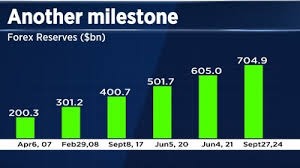
India's foreign exchange reserves have reached a historic milestone, surpassing $700 billion for the first time. This surge comes after seven consecutive weeks of increases, driven by valuation gains and dollar purchases by the Reserve Bank of India (RBI). As of September 27, the reserves stood at $704.89 billion, reflecting a rise of $12.6 billion in the latest week—marking the largest weekly increase since mid-July 2023. With this achievement, India joins an exclusive group of countries, becoming only the fourth economy globally to cross the $700 billion mark, alongside China, Japan, and Switzerland. Since 2013, when foreign investors withdrew due to weak economic indicators, India has been actively working to bolster its forex reserves. Measures to control inflation, coupled with robust economic growth and reduced fiscal and current account deficits, have attracted foreign investments, significantly enhancing reserves. So far this year, India has welcomed foreign inflows totaling $30 billion, primarily driven by investments in local debt after they were included in a major J.P. Morgan index. Gaura Sen Gupta, an economist at IDFC First Bank, noted that strong forex reserves help minimize currency volatility, providing the RBI with the necessary resources to intervene if needed. This stability boosts investor confidence, reducing the risk of sudden capital outflows. In 2024, India's forex reserves have grown by $87.6 billion, surpassing the nearly $62 billion increase seen in all of last year. Last week’s increase was bolstered by $7.8 billion in dollar purchases by the RBI and $4.8 billion in valuation gains, attributed to declining U.S. Treasury yields, a weaker dollar, and rising gold prices. The Indian rupee also strengthened past 83.50 against the dollar, prompting the RBI to step in to maintain its reserves. RBI Governor Shaktikanta Das previously indicated that maintaining lower volatility in the rupee is beneficial for the economy.