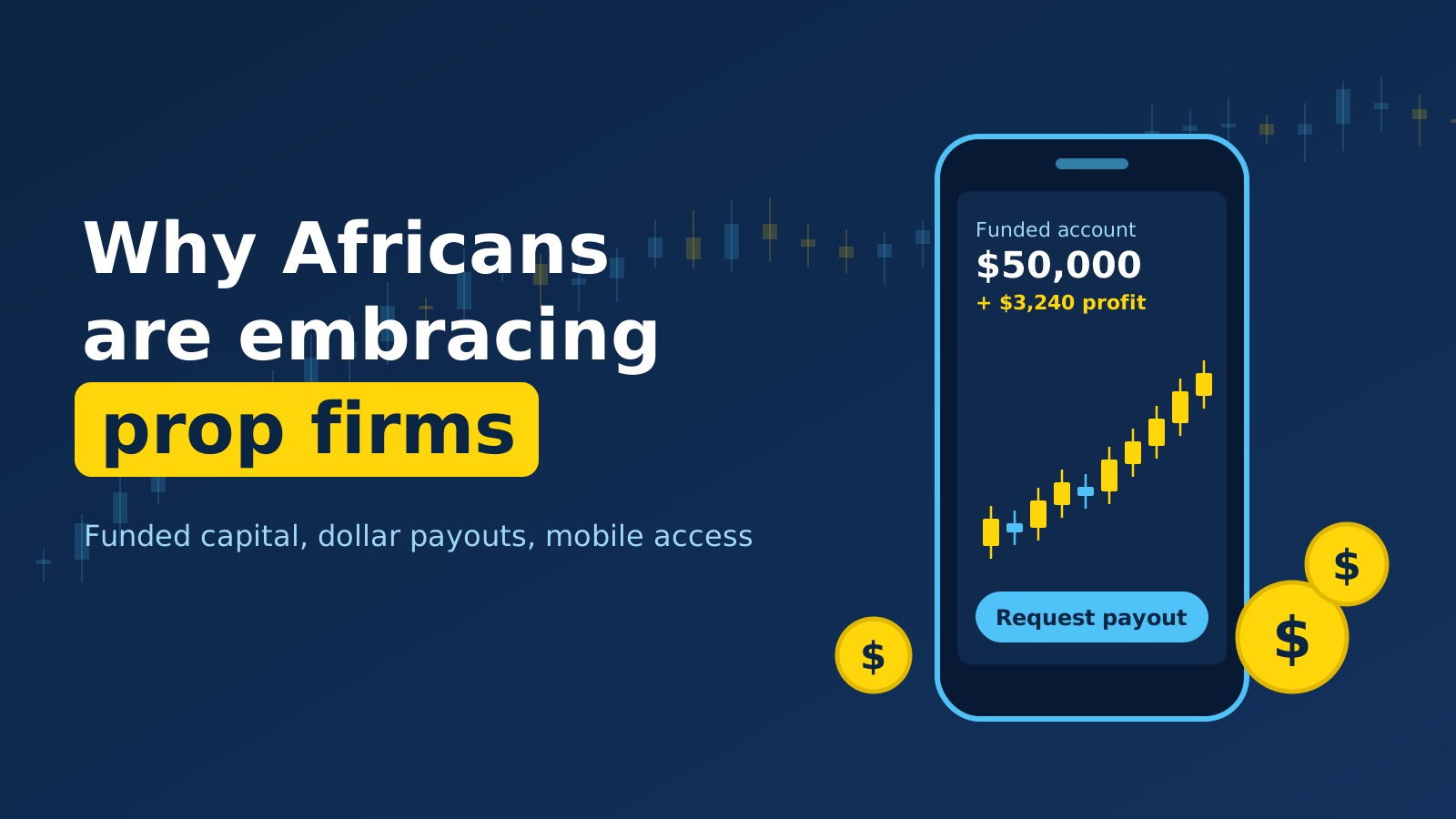
Across Lagos, Nairobi, Johannesburg and Accra, a growing number of young traders are skipping the slow road of saving up a trading account. Instead, they are turning to proprietary trading firms, or prop firms. These companies let traders manage the firm's capital in exchange for a share of the profits. For many Africans, that simple model solves problems that have kept them out of the financial markets for years.
Capital without the savings
The biggest draw is access to capital. Building a meaningful trading account on a local salary can take years, and a small account produces small returns even for a skilled trader. With a prop firm, a trader pays a one-time evaluation fee, often a few hundred dollars or less. If they pass the challenge, they can trade an account worth tens of thousands of dollars. Talent, not savings, becomes the main requirement.
Earning in dollars
Currency pressure is another powerful driver. Several African currencies, including the naira, the cedi and the Egyptian pound, have lost significant value against the US dollar in recent years. Prop firm payouts are usually made in dollars, often through crypto or international payment platforms. For traders watching local prices climb, a dollar income offers protection against inflation and a sense of financial stability that local jobs often can't match.
Low barriers to entry
Prop trading fits the way Africans already use technology. Africa is a mobile-first continent, and most prop firms run entirely online, with platforms like MetaTrader, cTrader and TradingView available on a phone. Sign-up takes minutes, and many firms offer free trials so traders can test the rules before paying. There are no office visits, no heavy paperwork and no need for a local broker relationship.
Community and education
Social media has turned prop trading into a shared movement. Telegram groups, YouTube channels, X threads and WhatsApp communities are full of African traders posting payout certificates, strategy breakdowns and firm reviews. Local mentors run classes and challenge-passing programmes. Seeing peers from the same city earn payouts makes the goal feel realistic, and the community gives newcomers a place to learn and ask questions.
The risks to weigh
The opportunity is real, but so are the risks. Most traders fail their evaluations, and repeated challenge fees can add up quickly. Some firms have changed rules suddenly, delayed payouts or shut down altogether. Prop trading is also lightly regulated in most markets. Traders should research a firm's payout record, read the rules carefully and treat each challenge fee as money they can afford to lose.
The bottom line
Africans are embracing prop firms because they remove the two biggest obstacles to trading: lack of capital and weak local currencies. Combined with mobile access and strong online communities, the model offers a genuine path to dollar income for skilled, disciplined traders. Those who approach it with patience, solid risk management and careful firm selection stand the best chance of turning a challenge into a career.