
C
Chaka
@chaka_muanzi
Last seen:
2 weeks ago
FX is my passion
0 Followers
0 Following
My take is retail trading cannot grant anyone financial freedom. I take trading as a means of just generating enough money to buy groceries. The markets are just too uncertain to rely on for a daily living. Sometimes it can take price a whole day to just move 15 pips
Liquidity sweep to me is when price rushes towards a certain level and then suddenly reverses sometimes leaving behind a wick. There is a lot of algo trading in the market today and these bots are programmed to buy low and sell high so they will always place their pending orders at levels where they think traders placed their stops. I also dont think it is big banks that cause most liquidity sweep scenarios I think it is just traders using automated bots to trade.
QUESTION: Which one is better betweeen Hedging a trade or using a Stop Loss?
I came across a video where a trader was marketing his robot that does hedging and he argued that he hardly loses trades because he hedges and that hedging is better than using stop loss. Please I would like to know your thoughts on this. Thanks you
Dont forget mental fatigue, when you trade too often it doesnt give your brain time to recover and you risk making bad decisions
I suggest you share the reason for the losses here if not whats the point of creating this thread? I also think those commenting on the thread should add more depth to what they are posting such as images and analysis.
It is highly dependent on the broker you are using, most low tier brokers will fail to execute the pending order but most tier-1 regulated brokers will always execute it although sometimes it may be executed at an inferior price. So, yea the pending order will get triggered but mind you the spreads are always high on such transactions.
Back in the day, whenever I read an article on best forex brokers and the editor put high leverage as one of the cons, I never understood why. I used to think high leverage should be one of the pros of a broker. But now I know better, high leverage is a time bomb waiting to explode when you are having a bad day and you feel like revenge trading to recover losses. High leverage will be there to enable you blow your account, it will allow you keep opening positions out of revenge only for the broker to close all the positions once price moves against you by as little as 1 pip and wipe off your account balance.
because when you wait 4 to 8 hours for a trade, it means when you finally execute it, you should let it run for the same amount of time.
But you said a close above the level will be a buy so why wait another 4 hours again? 4 hours is a lot of time to wait for a day trader
I almost forgot this feature exists. I need to start taking partial profits cos the markets have been messing with me recently, well done pat !
The idea behond this DCA strategy is that even if your first trade entry was sloppy and you were forced to set a wide stop loss, this strategy can help bring improve your average entry price if you place pending orders at better prices and wait for them to be triggered.
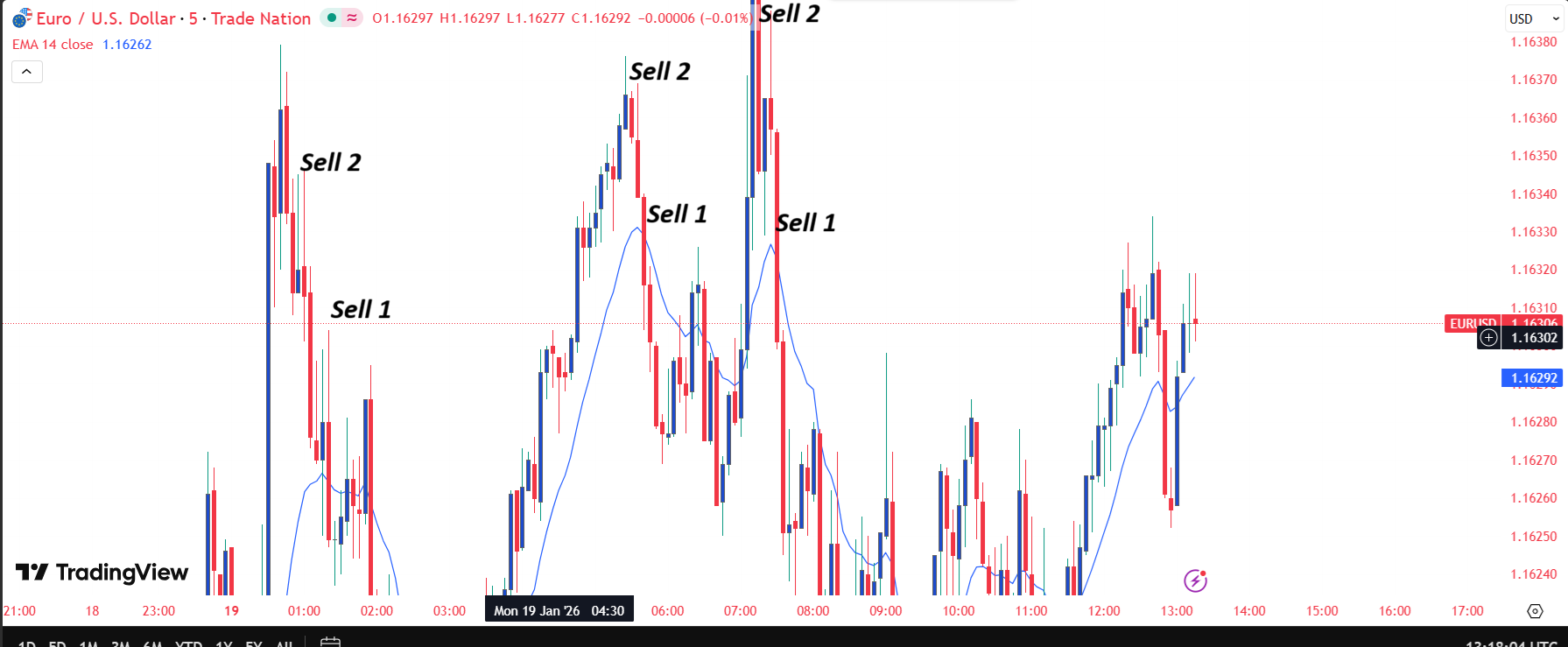
So in the attachaed chart we can see the price is falling from top to bottom and our sell trigger is the blue and red candle combo at the three tops. Normally when we see this most traders will sell after the trigger plus continuation is spotted (sell 1) which is okay. The DCA comes in sell 2 where you place a pending order to sell when price climbs up, thus you sell for higher an set a smaller stop loss than you would have set for sell 1. This is classic Dollar Cost Averaging style trading. So after spotting your entry trigger you wait for confirmation then enter the first trade. You then set pending orders above for selling or below for buying to capture a better entry price.
For the first trade on the left, sell 1 was at 1.1630 and sell 2 was around 1.1634 on the average the sell price is (1.1630 + 1.1634)/2 = 1.1632
For the second (middle) trade, sell 1 was at 1.1633 and sell 2 was around 1.1637 so the average sell price is (1.1633 + 1.1637)/2 = 1.1635
Dollar Cost Averaging (DCA) is actually a strategy used by stockmarket investors where they buy stock at fixed intervals even when the price is falling. So instead of just buying 1,000 stock at $10 per share on one day, they split the buying into different days.
On day one they can buy 10 shares, on day two they buy another 10 shares, on day three another 10 shares etc.
The idea behind this kind of buying is that on some days, the stock price would have fallen so the investor benefits from buying at a lower price.
In this strategy, I will apply the same DCA to trading currency pairs.
About 4% odds, not because you are not a good trader but because the prop firm trading rules are designed to make you trip and fall.
Showing 20 of 49 replies.
Log in to see all replies