
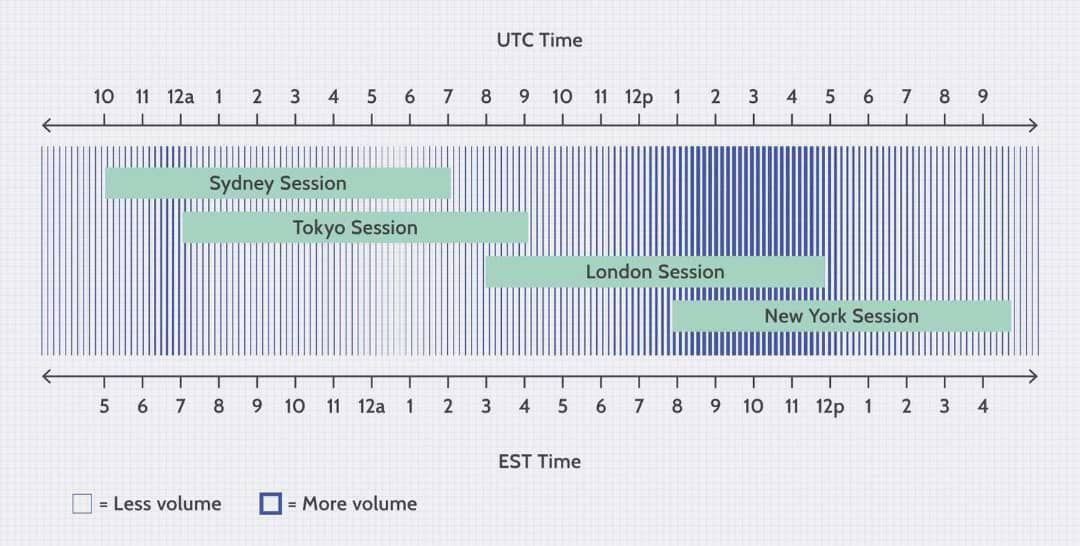
WHY UNDERSTANDING FOREX SESSIONS MATTERS📈
▫️Volatility: Different sessions exhibit varying levels of volatility. Understanding this can help you choose when to trade based on your risk tolerance.
▫️Liquidity: Sessions with higher liquidity offer tighter spreads and easier entry/exit from trades.
▫️News and Data: Major economic news and data releases often coincide with specific sessions, impacting currency movements.
▫️Trading Strategies: Some strategies are better suited for specific sessions based on their characteristics (e.g., news trading during active sessions, carry trading during quieter periods).
By understanding the forex trading sessions and their unique characteristics, you can make informed decisions about when and how to trade, potentially improving your success in the forex market.
BASIC FOREX TERMS📈
Here are some basic forex terms and their meanings;
▫️Currency Pair: The fundamental unit of forex trading, representing two currencies traded against each other. For example, EUR/USD represents the Euro versus the US Dollar.
▫️Base Currency: The first currency listed in a pair, used as the reference for the exchange rate. In EUR/USD, the Euro is the base currency.
▫️Quote Currency: The second currency listed in a pair, expressed as the price of one unit of the base currency. In EUR/USD, the US Dollar is the quote currency.
▫️Bid Price: The highest price a buyer is willing to pay for a currency pair. It's like the "asking price" in a store.
▫️Ask Price: The lowest price a seller is willing to accept for a currency pair. It's like the "selling price" in a store.
▫️Spread: The difference between the bid and ask prices. It represents the broker's commission for facilitating the trade.
▫️Lot: In forex trading, lot size refers to the standardized amount of currency units you're buying or selling in a single trade. Think of it like buying eggs; you wouldn't purchase individual eggs, but rather a carton (a lot) containing a specific number (e.g., 12).
▫️Pip: The smallest price movement for a currency pair. For example, in EUR/USD, a pip movement is 0.0001 (one cent for every $10,000 traded).
▫️Margin: A deposit required to hold open a leveraged position. Leverage allows you to control a larger position than your deposit, but also amplifies gains and losses.
▫️Long Position: Buying a currency pair with the expectation it will increase in value.
▫️Short Position: Selling a currency pair with the expectation it will decrease in value.
▫️Take Profit: A predetermined price level at which you close a profitable trade to lock in gains.
▫️Stop Loss: A predetermined price level at which you automatically close a losing trade to limit potential losses.
▫️Order Types: Instructions to your broker on how to enter or exit a trade, such as market orders, limit orders, and stop-loss orders.
▫️Technical Analysis: Using charts and indicators to predict future price movements based on historical data.
▫️Fundamental Analysis: Analyzing economic data and events to understand how they might affect currency values.
WHY LOT SIZE MATTERS📈
▫️Trading Capital: Smaller lot sizes are useful for beginners or those with limited capital, as they require less money per trade.
▫️Risk Management: Choosing a suitable lot size based on your account size and risk tolerance helps control potential losses.
▫️Profit & Loss: Your profit or loss is calculated based on the lot size and the pip movement of the currency pair.
WHAT IS A CURRENCY PAIR📈
In the realm of forex trading, currency pairs serve as the fundamental building blocks. They represent the exchange rate between two different currencies, essentially indicating how much of one currency you need to acquire one unit of the other.
ANATOMY OF A CURRENCY PAIR📈
Imagine you see the pair EUR/USD listed. Here's the breakdown:
▫️Base Currency: This comes first (EUR in this case). It acts as the reference point for the exchange rate.
▫️Quote Currency: This comes second (USD) and denotes its price in terms of the base currency. So, 1.2000 EUR/USD signifies you need 1.2000 USD to buy 1 EUR.
TYPES OF CURRENCY PAIRS📈
▫️Major Pairs: Highly traded pairs involving the US Dollar (USD), like EUR/USD, USD/JPY, and GBP/USD. They offer high liquidity and tight spreads.
▫️Minor Pairs: Less frequently traded, featuring major currencies against non-USD currencies (e.g., EUR/AUD, EUR/CHF). They have lower liquidity and wider spreads.
▫️Exotic Pairs: Pairs involving currencies from emerging markets or less-developed countries (e.g., USD/TRY, USD/ZAR). They boast even lower liquidity and wider spreads, but potentially higher volatility.