UNIJOS MTL COMMUNITY

P
@pisces03 - 13 hours ago

Let's talk about topics under risk management

P
@pisces03 - 12 hours ago
Quoted - pisces03

Let's talk about topics under risk management

1.What is a stop-loss?

2.What is take-profit?

3.What is risk-to-reward ratio?

4.What is position sizing?

5.Why is risk management important?

6.How much should a trader risk per trade?

7.What is drawdown?

Make everybody pick and answer

P
@pisces03 - 12 hours ago
Quoted - pisces03

1.What is a stop-loss?

2.What is take-profit?

3.What is risk-to-reward ratio?

4.What is position sizing?

5.Why is risk management important?

6.How much should a trader risk per trade?

7.What is drawdown?

Make everybody pick and answer

Number 1

A stop-loss is an automated order placed with your forex broker to buy or sell a currency pair once it reaches a specific price. It is designed to limit your potential financial loss on a trade if the market moves against you. Think of it as a safety net or an emergency brake for your trading account.

Here is a comprehensive breakdown of how it works, why it matters, and how to use it safely.

P
@pisces03 - 12 hours ago
Quoted - pisces03

Number 1

A stop-loss is an automated order placed with your forex broker to buy or sell a currency pair once it reaches a specific price. It is designed to limit your potential financial loss on a trade if the market moves against you. Think of it as a safety net or an emergency brake for your trading account.

Here is a comprehensive breakdown of how it works, why it matters, and how to use it safely.

⚠️ The Golden Rule: Risk of Capital LossBefore exploring advanced trading mechanics, you must understand that forex trading involves significant leverage. If you do not use risk-management tools like a stop-loss, it is entirely possible to experience a total loss of your trading capital, or even owe money beyond your initial deposit depen⚠️ The Golden Rule: Risk of Capital LossBefore exploring advanced trading mechanics, you must understand that forex trading involves significant leverage. If you do not use risk-management tools like a stop-loss, it is entirely possible to experience a total loss of your trading capital, or even owe money beyond your initial deposit depending on your broker's margin policies.

P
@pisces03 - 12 hours ago
Quoted - pisces03

⚠️ The Golden Rule: Risk of Capital LossBefore exploring advanced trading mechanics, you must understand that forex trading involves significant leverage. If you do not use risk-management tools like a stop-loss, it is entirely possible to experience a total loss of your trading capital, or even owe money beyond your initial deposit depen⚠️ The Golden Rule: Risk of Capital LossBefore exploring advanced trading mechanics, you must understand that forex trading involves significant leverage. If you do not use risk-management tools like a stop-loss, it is entirely possible to experience a total loss of your trading capital, or even owe money beyond your initial deposit depending on your broker's margin policies.

πŸ” How a Stop-Loss WorksWhen you enter a trade, you are making a prediction on which way a currency's value will go. A stop-loss acts as your "exit plan" for when your prediction is wrong.

In a Long Position (Buying): You buy a currency pair expecting its price to go up. You place a stop-loss below your entry price. If the price drops to that level, the broker automatically sells the position to prevent further losses.

In a Short Position (Selling): You sell a currency pair expecting its price to go down. You place a stop-loss above your entry price. If the price rises to that level, the broker automatically buys it back to close the trade.

P
@pisces03 - 12 hours ago
Quoted - pisces03

πŸ” How a Stop-Loss WorksWhen you enter a trade, you are making a prediction on which way a currency's value will go. A stop-loss acts as your "exit plan" for when your prediction is wrong.

In a Long Position (Buying): You buy a currency pair expecting its price to go up. You place a stop-loss below your entry price. If the price drops to that level, the broker automatically sells the position to prevent further losses.

In a Short Position (Selling): You sell a currency pair expecting its price to go down. You place a stop-loss above your entry price. If the price rises to that level, the broker automatically buys it back to close the trade.

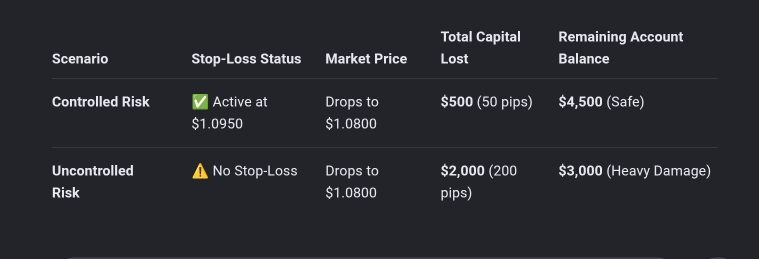
πŸ’‘ Simulated ExampleImagine you are trading the EUR/USD currency pair with a starting account balance of $5,000. You decide to buy (go long) because you believe the Euro will strengthen.

Account Balance: $5,000

Your Entry Price: $1.1000

Your Stop-Loss Price: $1.0950 (50 pips below entry)

Trade Size: 1 Standard Lot ($10 per pip)

If the market suddenly drops and hits $1.0950, your stop-loss order automatically triggers. Let's look at how this protects your portfolio compared to having no protection:

P
@pisces03 - 12 hours ago
Quoted - pisces03

πŸ‘‡πŸ‘‡

πŸ“Š Strategic Evaluation: Types of Stop-Loss OrdersNot all stop-loss orders behave the exact same way. Traders choose different types based on market conditions and their risk tolerance.

Standard Stop-Loss: The most common type. Once your specified price is reached, it becomes a market order. Hidden Cost Warning: In highly volatile markets (like major news releases), "slippage" can occur. This means your trade might be filled at a slightly worse price than you intended because the market moved too fast.

P
@pisces03 - 12 hours ago
Quoted - pisces03

Trailing Stop-Loss: A dynamic order that moves with the market. If you are in a buy trade and the price moves up, the trailing stop automatically moves up with it, maintaining a set distance (e.g., 20 pips). If the market reverses, it stays locked in place, helping you secure profits while still protecting against sudden drops.

Guaranteed Stop-Loss: Some brokers offer a stop-loss that guarantees execution at your exact price, completely eliminating slippage. Hidden Cost Warning: Brokers usually charge an extra fee or a wider spread to provide this guarantee.

P
@pisces03 - 12 hours ago
Quoted - pisces03

Guaranteed Stop-Loss: Some brokers offer a stop-loss that guarantees execution at your exact price, completely eliminating slippage. Hidden Cost Warning: Brokers usually charge an extra fee or a wider spread to provide this guarantee.

πŸ“ˆ Diversification and Risk Mitigation FrameworkA stop-loss is only one part of a healthy trading strategy. To prevent total capital destruction, professional traders use a strict framework:

1. The 1% to 2% Rule: Never risk more than 1% to 2% of your total account balance on a single trade. If you have a $5,000 account, your stop-loss should be positioned so that if it gets hit, you only lose $50 to $100.

P
@pisces03 - 12 hours ago
Quoted - pisces03

2. Technical Placement: Do not just pick a random number for your stop-loss. Place it just outside of key technical areas, such as recent support or resistance levels, or use volatility indicators like the Average True Range (ATR).

3. Portfolio Diversification: Avoid opening multiple trades that are highly correlated (for example, buying EUR/USD, GBP/USD, and AUD/USD all at once). Because these pairs all move heavily against the US Dollar, a single market event could hit all of your stop-losses simultaneously, multiplying your losses.

V
@victory - 12 hours ago
Quoted - pisces03

I dey....

I dey active

Oyana

Where are the others?

V
@victory - 11 hours ago
Quoted - pisces03

1.What is a stop-loss?

2.What is take-profit?

3.What is risk-to-reward ratio?

4.What is position sizing?

5.Why is risk management important?

6.How much should a trader risk per trade?

7.What is drawdown?

Make everybody pick and answer

Number 2

A Take Profit (TP) order is a preset instruction that automatically closes a winning trade once the price hits a specific target level. It ensures you lock in your gains before the market reverses against you.

Think of it like an automated exit strategy. You do not need to sit at your screen watching charts; the trading platform executes the order for you instantly.

V
@victory - 11 hours ago
Quoted - victory

Number 2

A Take Profit (TP) order is a preset instruction that automatically closes a winning trade once the price hits a specific target level. It ensures you lock in your gains before the market reverses against you.

Think of it like an automated exit strategy. You do not need to sit at your screen watching charts; the trading platform executes the order for you instantly.

How It Works in Practice

When you open a trade, you establish two boundaries to manage your money: a Stop Loss (to limit damage if you lose) and a Take Profit (to capture gains if you win).

Buying (Going Long): You expect the price to rise. You place your TP above the current market price.

Selling (Going Short): You expect the price to fall. You place your TP below the current market price.

Disclaimer:

At MyTradingLand.com, we connect you with forex brokers and provide a community for traders. While we offer valuable information and resources, please note that we are not financial advisors and cannot provide personalized financial advice. Always conduct your own research and invest responsibly.

Community Guidelines: The MyTradingLand.com community is designed as a resource for forex traders, promoting respectful and constructive discussions. We reserve the right to remove any content that is misleading, abusive, or violates our terms of service.

Broker Information: While we may receive commissions or advertising income from some of the brokers listed, this does not imply an endorsement of any broker, nor does it affect our review process. Our evaluations are based solely on objective criteria and user feedback.

Always verify the regulatory status of any broker with your local financial authority, along with their terms and privacy policies, before engaging with them. It is crucial to conduct thorough research to ensure that you are making informed decisions.

Risk Warning: At MyTradingLand.com, we strive to provide accurate information; however, the forex market is highly volatile and can change rapidly. It is essential to verify any information before making investment decisions.

Please be aware that trading in forex involves substantial risk, and it is possible to lose more than your trading equity/investment capital. 70-90% of retail CFD traders incur losses in their trading activities as per information from various brokers.

You are solely responsible for your use of MyTradingLand.com and any trading decisions you make. We encourage all users to educate themselves thoroughly about forex trading and to consider seeking advice from qualified financial professionals.

Advertising Disclosure: We may earn commissions from recommended brokers, but our reviews are independent (not influenced by potential earnings). Sponsored content is clearly marked and doesn't reflect our views.

©2026 Β©2025 All rights reserved Mytradingland.com